For most of my childhood, I lived in a state of self-imposed exile. I was a child with a biological father who was merely a memory and a stepfather, Mark, who was an omnipresent reality. Mark was a man of quiet consistency—he was the one in the front row at every play, the one who held the back of my bike seat until I wobbled into balance, the one who navigated the awkward, silent tension of every parent-teacher conference I made sure to make difficult.
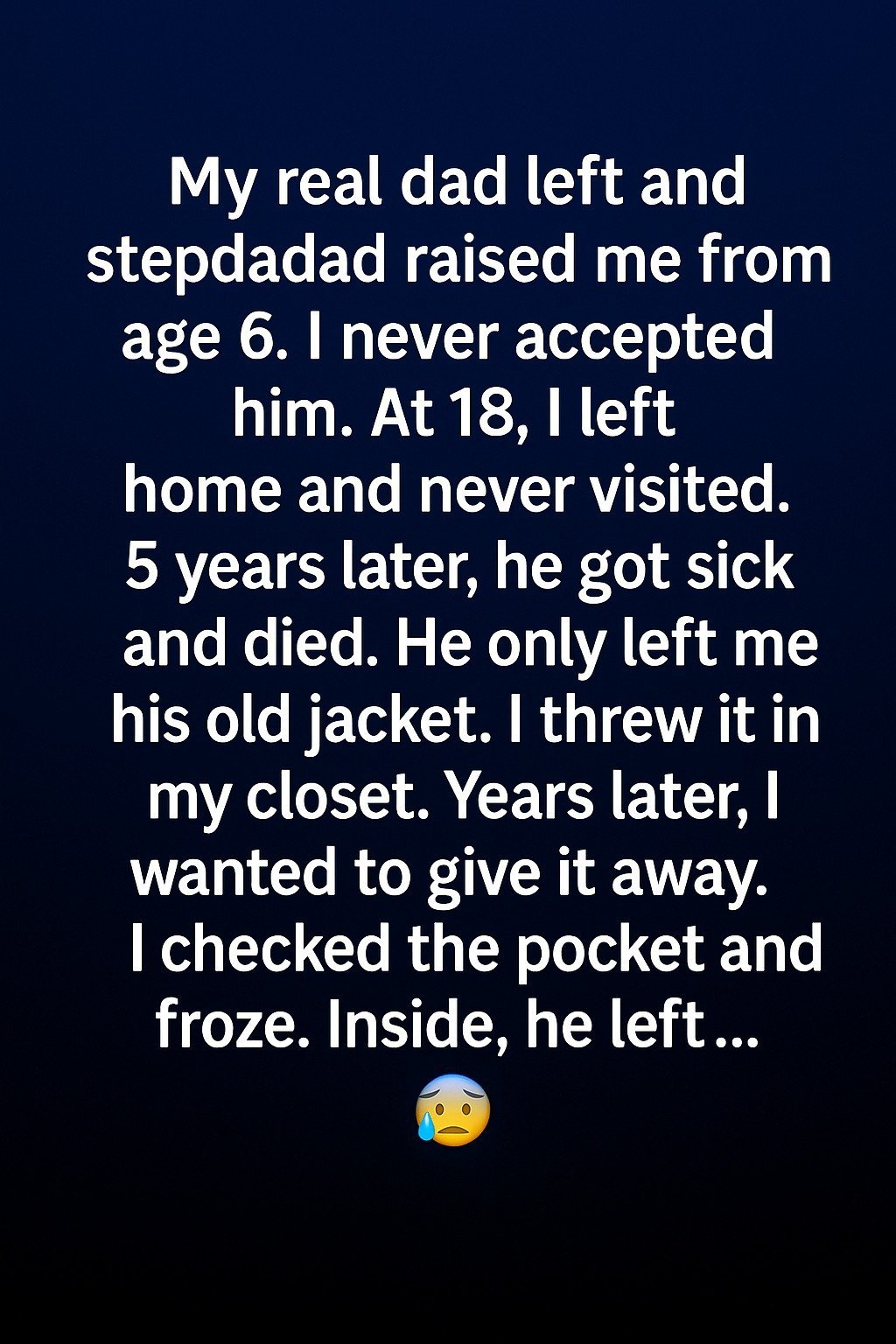
I treated his devotion as an intrusion. In my young, fractured mind, I had constructed a fortress of “loyalty.” To love Mark, I reasoned, would be a betrayal of the man who had abandoned me. I saw Mark’s attempts at connection not as gifts, but as attempts to usurp a throne that only my biological father was entitled to. I became an expert at the cold shoulder, the clipped response, and the art of looking through someone who was trying, with every fiber of his being, to be seen.
When I turned eighteen, I used college as a permanent escape hatch. I didn’t just leave; I severed. For five years, I lived in a vacuum of my own making, ignoring the milestones of his aging and the quiet, persistent pulse of home. I thought I was free. In reality, I was just starving myself of the very love I had spent years trying to deflect.
Then came the phone call on a grey, mid-winter morning. My mother’s voice didn’t just tremble; it shattered. Mark was gone.
The funeral was a blur of black fabric and performative grief, but when my mother handed me his old, frayed jacket, the reality finally bit. It was a tangible piece of him—heavy, smelling of cedar and the faint, lingering scent of his aftershave. I rejected it. I tossed it into the back of my closet like a piece of evidence I didn’t want to examine, burying it under layers of old clothes and older regrets. To me, it wasn’t a keepsake; it was a mirror of my own failures.
Years bled into one another. I became a different person—older, busier, perhaps a bit kinder—but the jacket remained, a dormant secret in the dark of my closet.
One afternoon, in a fit of efficiency, I decided to purge. I pulled the jacket out, ready to fold it into a donation bag, when my fingers brushed against something stiff in the lining of the pocket. I pulled it out. It was a photograph—me, at seven years old, a gap-toothed, wild-eyed grin captured in a moment of pure, unadulterated joy. Beneath it was a folded slip of paper.
I didn’t read it immediately. My heart was pounding, a strange, rhythmic warning in my chest. When I finally unfolded it, the handwriting was shaky, the ink faded, but the message was a lightning bolt:
“Even if you never call me ‘Dad,’ raising you has been the greatest honor of my life. I’m proud of you, and I’ll love you forever. — Mark.”
The world tilted. I sank to the floor, the jacket clutched to my chest like a shield. The wall I had built for fifteen years didn’t just crumble; it turned to dust. I realized, in the agonizing silence of that room, that while I had been busy protecting a loyalty to a ghost, Mark had been busy building a sanctuary for me. He hadn’t asked for my permission to love me. He hadn’t required my approval to be my father. He had simply, quietly, stayed.
I wept for the years I had stolen from him, for the words I had withheld, and for the man I had forced to love me from the periphery of my life. He hadn’t needed to be my biological father to hold my heart—I had held the key to his all along, and I had been too blind to see it.
From that day forward, I stopped living for the ghost who had left. I started living for the man who chose to stay. I learned that while blood may connect us to our past, it is the deliberate choice to show up, day after day, that defines our future. Mark was my father in every way that mattered, and though he would never see me grow into the person I am today, I carry his love now, not as a weight, but as a compass.