The moment Eleanor Mitchell realized her son no longer deserved his father’s legacy did not happen inside a hospital room.
It wasn’t the night Richard Mitchell finally lost his battle with cancer after eight brutal months of treatment. It wasn’t the sound of the heart monitor flattening into one endless tone while doctors quietly lowered their eyes. It wasn’t even the evening Richard, weak from illness but still sharp in mind, reached for Eleanor’s hand and whispered, “Promise me you’ll do what’s right, not what’s easy.”
No.
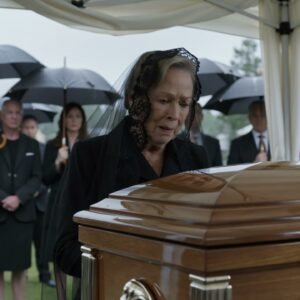
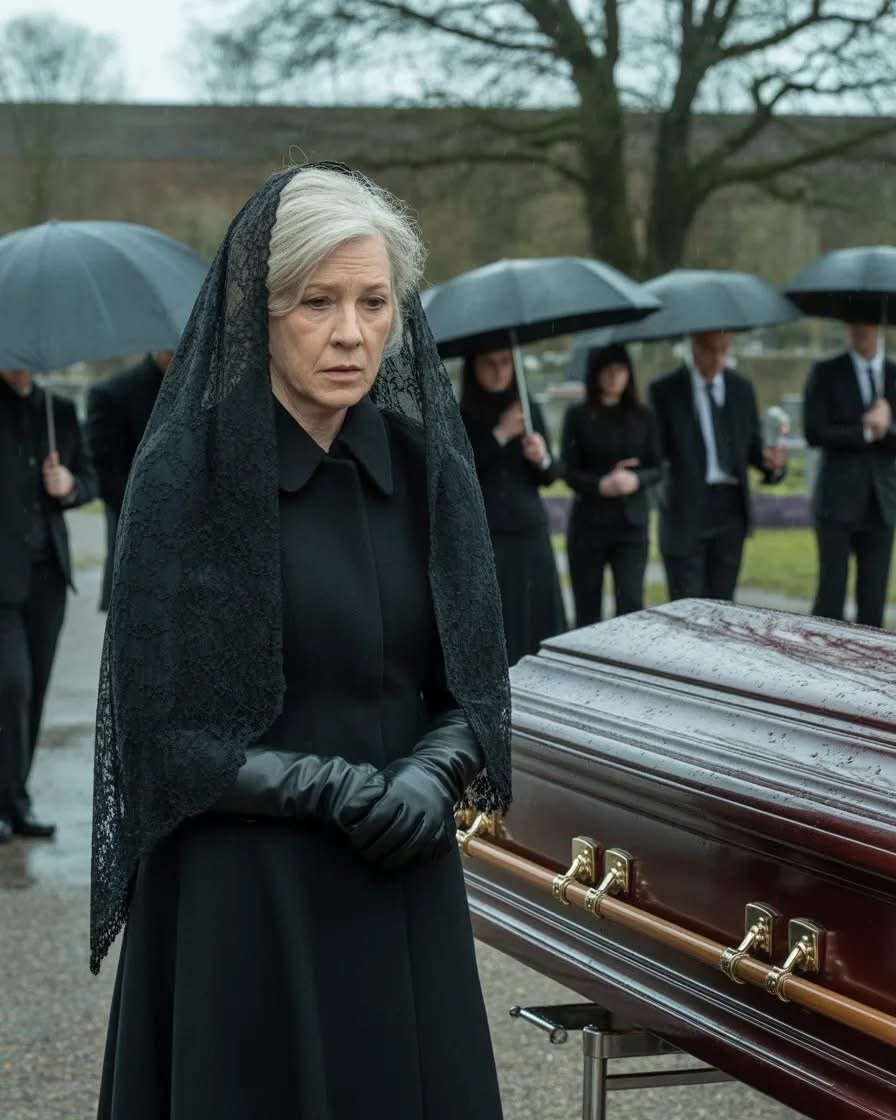
The truth arrived later, beneath cold November rain at Rosehill Cemetery in Chicago.
Richard Mitchell, founder of Mitchell Shipping, husband of forty-five years, father of one son, grandfather of one granddaughter, had just been laid to rest.
Rain battered the green funeral canopy while mourners stood shoulder to shoulder beneath black umbrellas. Executives, dockworkers, old family friends, and longtime employees filled the cemetery despite the freezing wind rolling in from Lake Michigan.
And beside Eleanor, in the front row, one chair remained empty.
Thomas Mitchell’s chair.
Their only son.
The boy Richard had once carried through muddy shipping docks while explaining freight routes like bedtime stories. The boy he had sent to elite schools, then Georgetown, then Wharton, before handing him a prestigious office and every possible advantage a father could provide.
The son Richard had defended for years, long after excuses stopped sounding temporary and started sounding permanent.
But Thomas wasn’t there.
Richard’s casket rested beneath the rain while his son attended a birthday celebration in Aspen.
Jennifer Avery, Richard’s longtime executive assistant, stepped quietly beside Eleanor and squeezed her gloved hand.
“He said he’d try to make it back before the burial,” Jennifer whispered carefully. “Victoria’s party ran longer than expected.”
Eleanor stared at the polished casket without speaking.
Victoria’s birthday party.
Champagne. Imported flowers.
Celebrity guests flown in from Europe and Los Angeles. Eleanor had heard about the event repeatedly during Richard’s final week alive because Victoria treated the timing of Richard’s death like an inconvenience disrupting her social calendar.
And Thomas had gone with her.
The funeral director approached slowly, rain dripping from the brim of his hat.
“Mrs. Mitchell,” he said softly, “would you like us to wait a little longer?”
Around them, people shifted awkwardly.
Dockworkers lowered their eyes. Company executives pretended not to notice the empty seat. Charlotte, Thomas’s twenty-two-year-old daughter, sat nearby with tears streaming silently down her face.
Eleanor looked at the vacant chair again.
For decades she had protected Thomas from consequences.
Every missed holiday had an explanation. Every selfish decision had context. Every disappointment came wrapped in excuses she invented because facing the alternative felt unbearable.
He’s stressed.
He’s immature.
He’ll grow up eventually.
He means well underneath it all.
But standing beside Richard’s grave while rain hammered against the canopy, Eleanor finally stopped lying to herself.
“Begin,” she said.
The pastor opened his Bible.
As prayers drifted through the cemetery, Eleanor barely heard them.
Her thoughts had already returned to the conversation she and Richard shared three weeks earlier inside his hospital room overlooking downtown Chicago.
It had been past midnight. The city lights glowed gold beyond the glass while Richard lay weak against white pillows, thinner than Eleanor had ever imagined possible. The illness had hollowed him physically, but not mentally.
His eyes remained clear.
“He’s not ready,” Richard had said quietly.
Eleanor knew immediately who he meant.
“Thomas will step up,” she replied automatically. “When the time comes, he’ll surprise us.”
Richard laughed once, but the laugh dissolved into a violent cough.
When he recovered, he pointed weakly toward the leather folder sitting on the bedside table. Walter Harrington, his attorney of thirty years, had delivered it earlier that afternoon.
“That’s why I changed the documents,” Richard said.
Eleanor felt dread immediately.
“Richard…”
“The final decision belongs to you.”
“No.”
“Yes.”
His voice weakened, but his eyes didn’t.
“You’ll know what to do when the moment comes.”
She wanted to argue.
She wanted to believe grief might finally wake something inside their son. That maybe, once Richard was truly gone, Thomas would rediscover the man he used to be.
But Richard had already accepted a truth Eleanor still resisted.
At the cemetery, the casket slowly lowered into the earth.
Charlotte broke down beside her.
Eleanor reached across the empty chair where Thomas should have been and held her granddaughter’s trembling hand.
The funeral reception afterward took place inside the Mitchell penthouse overlooking Lake Michigan. The apartment occupied the top floors of an elegant glass tower, filled with polished wood, antique sculptures, and panoramic city views Richard had always claimed were beautiful enough to keep him humble.
“I started on a dock that smelled like diesel fuel and dead fish,” he used to joke.
“A man shouldn’t forget where he began.”
That afternoon, the penthouse filled with people who remembered exactly where he began.
Old employees shared stories while servers moved quietly through the rooms. A retired dock supervisor recalled Richard secretly paying medical bills for a worker’s wife. A former accountant remembered Richard staying overnight during payroll emergencies so employees wouldn’t miss Christmas paychecks.
Executives spoke about how fiercely Richard protected workers during recessions, even when investors pushed for layoffs.
Eleanor accepted condolences politely, but every few minutes her eyes drifted toward the elevator.
Still nothing from Thomas.
At 6:27 p.m., the elevator doors finally opened.
Thomas walked in wearing an expensive charcoal suit untouched by rain. Beside him, Victoria stepped elegantly onto the marble floor in an emerald dress completely inappropriate for a funeral reception, diamonds glittering around her throat.
“Mother,” Thomas said casually.
He kissed Eleanor’s cheek like he was attending a networking event instead of his father’s wake.
“Sorry we missed most of the service,” he added. “Victoria’s party schedule got complicated.”
Silence spread through the room.
Charlotte stared at her father with visible disbelief.
Jennifer Avery looked physically sick.
Eleanor studied her son carefully.
For the first time in years, she stopped seeing him as the child she raised and saw him clearly as the man he had become.
Not wounded.
Not misunderstood.
Just selfish.
“The will reading is tomorrow morning,” Eleanor said evenly. “Walter Harrington requested all beneficiaries attend.”
Thomas sighed impatiently.
“Victoria and I planned to fly back to Aspen tonight,” he said. “Can’t legal handle it later?”
Jennifer inhaled sharply.
Margaret Mitchell, Richard’s younger sister, closed her eyes in disgust.
“No,” Eleanor said.
Something in her tone finally caught Thomas’s attention.
“You need to be there,” she continued.
“Or the consequences may become significant.”
For the first time all evening, uncertainty crossed his face.
But only briefly.
“Fine,” he muttered. “We’ll stay.”
Victoria said nothing, though her eyes wandered openly across the penthouse, lingering on sculptures, artwork, and antique collections with unmistakable calculation.
She wasn’t grieving Richard.
She was evaluating inventory.
Late that night, after the final guests left, Eleanor entered the bedroom she had shared with Richard for over four decades. His robe still hung behind the bathroom door.
His reading glasses rested untouched on the nightstand.
The silence inside the room felt unbearable.
Behind Richard’s portrait above the fireplace sat a hidden wall safe. Eleanor entered the code slowly and opened it.
Inside was an envelope labeled in Richard’s handwriting.
My Dearest Eleanor.
Her hands trembled as she opened it.
“If you are reading this,” the letter began, “then two things have happened. I’ve died… and Thomas has finally shown you who he truly is.”
Eleanor closed her eyes.
Tears blurred the page as she continued reading.
Richard admitted what he had hidden for years: he no longer trusted their son with the future of Mitchell Shipping.
He blamed himself for giving Thomas privilege before discipline, comfort before accountability. Most importantly, he reminded Eleanor that the company represented far more than wealth.
It represented thousands of families.
Pensions.
Mortgages.
Scholarships.
Workers who depended on leadership that understood responsibility.
Then came the final instruction.
“If Thomas proves himself disrespectful, negligent, or unworthy during my final days,” Richard wrote, “invoke the clause.”
Eleanor read the sentence again.
And again.
By sunrise, she had read the entire letter thirteen times.
And before the sun fully rose over Lake Michigan—
She made her decision.
At 9:52 the next morning, Eleanor Mitchell walked into the conference room at Harrington & Associates carrying Richard’s letter inside her handbag like it weighed a hundred pounds.
The room had been intentionally designed to intimidate people. Dark mahogany walls.
Long polished table. Brass lamps casting warm light over leather chairs. Walter Harrington believed serious family matters deserved serious surroundings, and over four decades as Chicago’s most feared estate attorney, he had learned that wealth rarely brought dignity into inheritance battles.
Ten people already sat waiting.