
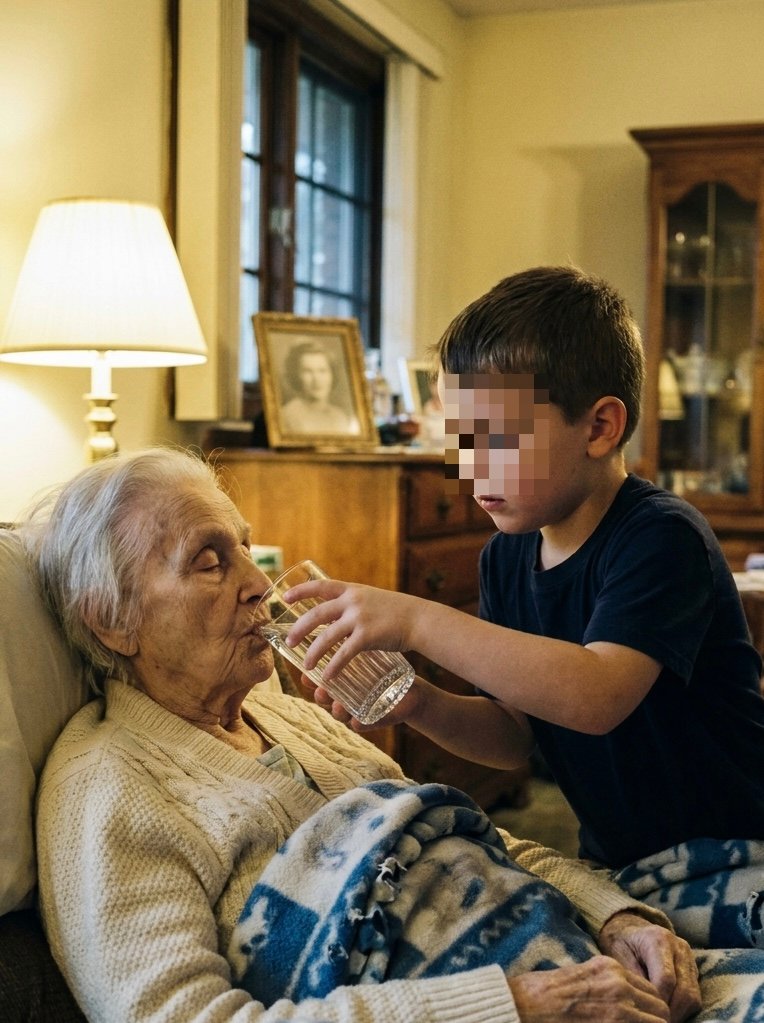
For three years, Harry thought he was simply helping a lonely neighbor. But after Grace’s house went dark for the last time, a sealed box appeared in his yard and changed everything he thought he knew about kindness, loss, and family.
At first, it was just small things.
Harry was ten when he first noticed Grace struggling on the sidewalk outside her little blue house.
Everyone in the neighborhood knew the elderly woman with the silver bun, pale cardigans, and slow steps.
She kept her curtains half open during the day and watered the flowers on her porch even when her hands shook too much to hold the can steady.
That afternoon, Harry had been riding his bike in lazy circles near his driveway when Grace’s taxi pulled up. The driver placed three grocery bags by the curb and left before Grace could bend down for them.
She reached for the first bag, wincing as if even the air had weight.
For a second, he hesitated. He was a shy boy, the kind who answered adults with nods and mumbled “yes, ma’am” into his collar. But Grace’s fingers trembled around the plastic handles, and one bag tilted dangerously, a carton of eggs pressing against the side.
He dropped his bike on the grass and ran over.
“Let me help you,” he said, taking the bags from her trembling hands.
Grace blinked at him, startled. Then her face softened into a tired smile.
Harry shrugged, suddenly embarrassed. “They looked heavy.”
“They are,” she admitted, pressing a hand against the gate. “Heavier than they used to be.”
He carried the bags up her front steps and into a kitchen that smelled like lemon soap, medicine, and old books. The counters were spotless, but the house felt too quiet. No television hummed in the background. No footsteps moved through the hallway. No voice called from another room.
“Where should I put these?” Harry asked.
“On the table, dear. Thank you.”
When he turned to leave, Grace reached for the edge of a chair to steady herself.
The next day, he came back.
He did not tell himself he was doing anything important. He just knocked on her door after school and asked if she needed anything from the corner store. Grace looked surprised again, then amused, then grateful in a way that made Harry’s chest feel tight.
He kept coming back.
Sometimes he brought her food his mother had packed in a container. Soup when Grace had a cough. Banana bread when his mother baked too much. A plate of rice and chicken, when Grace admitted she had forgotten to eat lunch.
He dusted the shelves lined with framed photos, shook out the little rug near the door, and carried laundry baskets from the hallway to the machine. Grace tried to protest at first.
“You’re too young to be doing chores for an old woman,” she would say.
Harry would grin and keep wiping the table. “I do chores at home anyway.”
“That does not mean you need more of them.”
“It’s okay.”
Over time, Grace became part of his days in a way he did not question. He stopped by after school before doing homework. On Saturdays, he helped pull weeds from her front garden.
On rainy evenings, he sat beside her in the living room while the windows fogged and soft voices drifted from the television. Sometimes they talked for hours, sometimes they just sat in silence, watching old TV shows together.
Harry learned that Grace liked her tea with a little milk but no sugar. He learned that she hated it when the news came on too loudly. He learned that she kept peppermints in a glass bowl for visitors, though no visitors ever seemed to come.
One evening, while a black-and-white comedy played on the television, Grace looked at him instead of the screen.
“You remind me of my grandson,” she once told him softly.
Harry looked down at the peppermint wrapper in his hands.
He wanted to ask why. He wanted to ask where the grandson lived, whether he called, whether Grace missed him every day, or only on the quiet ones. But there was something in her voice that warned him not to touch the question.
So he didn’t ask questions.
He just kept showing up.
Harry grew taller. His voice started to change. His bike was replaced by walking home with a backpack slung over one shoulder. Grace grew thinner. Her steps became slower.
Some days, she could not make it to the porch at all, so Harry let himself in with the spare key beneath the chipped flowerpot, calling her name before stepping inside.
Then one day, the lights in her house never turned on again.
Harry stood at his bedroom window that evening, staring across the yard. Grace’s front room stayed dark. No blue glow spilled from the television. No lamp warmed the space beside her chair.
His parents told him gently. “She passed away.”
He didn’t say much. He couldn’t. He just nodded, but something in him felt empty.
A week later, he walked into the yard early in the morning and suddenly stopped.
There was a box sitting right in the middle of the grass.
Old, carefully sealed, with his name written on it.
“Mom?” he called out. “Did you put this here?”
“No,” she answered from inside the house.
He slowly walked closer, his heart pounding.
It didn’t make sense.
No one had been there.
Inside the box, Harry found a folded blue sweater, a small photo album, and an envelope with his name written in Grace’s careful handwriting.
For a moment, he could not move.
The morning air felt cold against his face, but his cheeks burned. He touched the envelope with two fingers, afraid that if he opened it too fast, the last piece of Grace would disappear.
His mother stepped onto the porch behind him. “Harry? What is it?”
“I don’t know,” he said quietly. “It’s from her.”
His mother came down the steps but stopped a few feet away, as if she understood he needed to be the first one to see it.
There was a letter inside.
Harry pressed his lips together. The words blurred, so he wiped his eyes with his sleeve and kept reading.
His mother covered her mouth, but she did not speak.
Harry stared at the letter. He remembered the way Grace had said those words, soft and careful, as if they had hurt her throat.
A sound slipped from Harry’s chest. It was not quite a sob, but it shook him.
His mother knelt beside him and put an arm around his shoulders. “Oh, sweetheart.”
It was soft and a little faded, with uneven stitches near one sleeve. He held it against his chest, and for the first time since his parents had told him Grace was gone, he cried openly.
“I should have been there,” he whispered. “I should have checked on her that day.”
His mother tightened her hold. “Harry, you were there for her for three years. You gave her more than most people give in a lifetime.”
“No,” his mother said gently. “Because of you, she wasn’t.”
Harry looked back into the box and found the photo album. The first pages showed Grace as a young woman, laughing in a garden. Then came pictures of a little boy with dark hair, missing front teeth, and bright eyes. Her grandson.
Tucked into the final page was a photograph Harry had never seen before.
It was him and Grace.
His mother had taken it on Grace’s porch after Harry fixed the loose leg on her flower stand. Grace sat in her chair with a blanket over her knees, and Harry stood beside her, grinning awkwardly while she held his hand.
On the back, Grace had written: “My chosen grandson.”
Harry traced the words with his thumb.
That afternoon, he carried the box inside and placed the photo on his desk. A week later, when Grace was buried beneath the maple trees at the small cemetery near town, Harry wore the blue sweater under his coat.
At the service, a man he did not recognize stood far from everyone else, crying into his hands.
He was Grace’s grandson.
The man approached him after the service. His voice broke as he asked, “Are you Harry?”
Harry nodded.
“She wrote about you,” the man said. “She said you showed up when I didn’t.”
Harry did not know what to say, so he only answered, “She missed you.”
The man closed his eyes. “I know.”
Harry looked toward Grace’s grave, where the flowers trembled in the wind.
For years, he had thought he was helping Grace carry groceries, clean rooms, and pass lonely hours.
Grace had been helping him, too.