
Signature comparisons. When I left, I sat in my car and rested my forehead against the steering wheel for a moment. This wasn’t how I had imagined honoring Margaret’s memory.
But staying silent would have dishonored her far more. Three days passed before the call came. The detective’s voice was calm.
“We’re going to the house today. I wanted you to know.”
She didn’t ask me to come. She simply gave me the choice.
I drove there slowly. When I turned onto the block, I parked across the street—far enough away that no one would notice me. The house looked exactly the same.
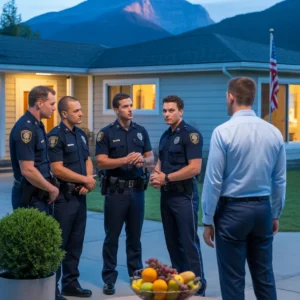
Ryan’s car sat in the driveway. Lisa’s sat behind it. A police cruiser turned the corner—lights off—and rolled to a stop in front of the house.
Another followed. Doors opened. Two officers stepped out and walked up the path.
From across the street, I watched Ryan appear in the doorway, posture confident and relaxed. I couldn’t hear the words, but I saw his expression shift as the officers spoke. Confusion.
Then irritation. Then something sharper. Lisa came up behind him, peering over his shoulder.
Her mouth moved quickly. One of the officers held up a hand, stopping her mid-sentence. Another stepped forward and asked them both to come outside.
That was when the handcuffs came out. The moment was quieter than I had imagined. No shouting.
No dramatic struggle. Just the soft click of metal closing around wrists. Ryan’s mouth fell open.
Lisa’s face went pale. The officers read them their rights, voices steady and practiced. I watched from across the street, unseen.
Unnoticed. As they were led down the steps, Ryan’s eyes scanned the street, frantic now. They didn’t land on me.
I stayed still. The officers helped them into the cars and closed the doors. The sound echoed softly.
As the cars pulled away, the street settled back into stillness. The house stood open and empty, the front door swinging slightly in the breeze. I sat there a long moment, my engine idling.
I didn’t feel triumph. I didn’t feel satisfaction. What I felt was a quiet alignment, as if something deeply wrong had finally been corrected.
Eventually, I started the car and drove away. I didn’t go inside. I didn’t need to.
The court process moved slowly. Weeks turned into months, marked by envelopes and phone calls. Filings.
Motions. Hearings set and postponed. Through it all, the facts stayed the same.
The forged will. The recorded video. The journals.
The signatures that didn’t match. Evidence doesn’t argue. It waits.
When the plea negotiations began, Mr. Harris called. “They’ve retained counsel.
And they’ve seen what we have.” He paused. “They’re prepared to plead guilty to forgery and fraud.”
The word settled into place. Guilty.
Not misunderstood. Guilty. The day the pleas were entered, I sat in the back of the courtroom, unnoticed.
When the judge asked how they pleaded, their voices were barely audible. “Guilty.”
Sentencing followed weeks later. The judge spoke plainly, outlining the harm caused.
Ryan received a custodial sentence with a portion suspended, along with significant fines. Lisa received a shorter term and probation. The gavel came down once—clean and final.
The will was executed without delay. The house transferred into my name. The funds were released according to Margaret’s instructions.
Ryan and Lisa asked to speak to me once, through their attorneys. I agreed to a brief meeting. They sat across from me.
Ryan spoke first. He apologized. He said the words people say when they’ve run out of options.
I listened without interrupting. When they finished, the room went still. “I hear you,” I said.
“But I’m not ready to forgive.”
I didn’t raise my voice. I simply told the truth. Forgiveness, I had learned, isn’t an obligation.
It’s a choice that requires time and safety. I moved back into the house on a quiet morning. I opened windows and let light spill across floors.
I unpacked slowly. I returned photographs to shelves. I placed Margaret’s favorite mug back in the kitchen cabinet.
That night, I slept in my old room and woke to a silence that felt earned. I didn’t sell the house. The house wasn’t a burden to me.
It was a record. I used part of the money Margaret left me to start something small. A place where caregivers could come once a week, sit in a circle, and speak without explaining themselves.
I called it At Margaret’s House. We met in my living room at first. The first meeting had four people.
By the third month, there were fifteen. We shared resources. Legal information.
The names of doctors who listened. But more than that, we shared the nights no one else saw. I didn’t lead the group as an expert.
I sat with them as someone who had been there and survived. In the backyard, I planted a garden. Roses, mostly—because Margaret had loved them.
On warm afternoons, I sat outside and let the sun touch my face. No alarms. No one waiting for me to move faster.
Some nights, I walked through the rooms and felt the presence of everything that had been without being trapped by it. I spoke to Margaret sometimes—out loud—telling her about the group, about the people she would have liked. I thanked her, not just for the house or the money, but for seeing me clearly when it mattered most.
People still ask if I’ll ever forgive Ryan. I tell them the truth. “I don’t know.”
Forgiveness isn’t a finish line.
It’s something that unfolds—or doesn’t—depending on what comes after. What I do know is this: I no longer confuse forgiveness with access. Boundaries aren’t punishment.
They’re protection. Loving someone doesn’t require surrendering your life to their expectations.