
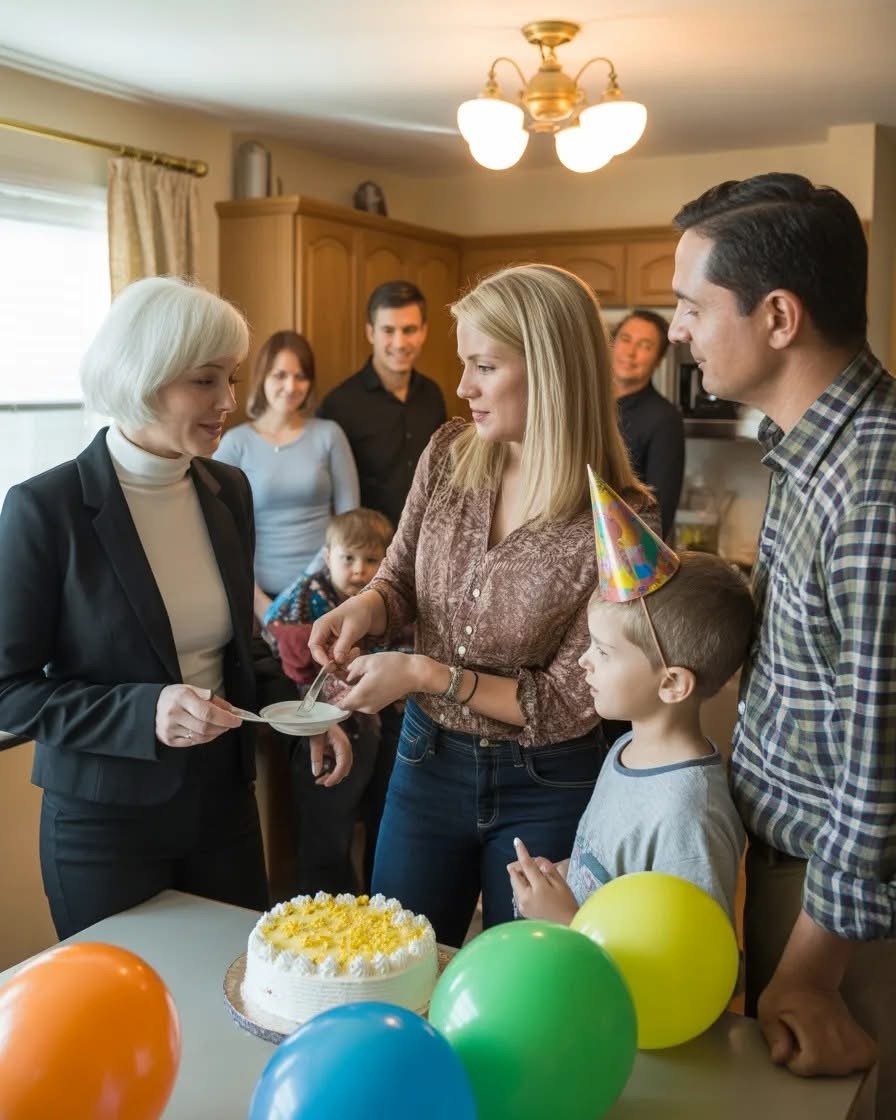
Her boundary had been necessary. She knew that. But now the real people inside the consequences were impossible to ignore—especially Liam, who had done nothing wrong.
That Wednesday, Daniel showed up at her house alone.
He looked older than forty.
Not dramatically, just worn: dark circles under his eyes, stubble on his jaw, shoulders bent in a way she had never seen before. He did not wait for an invitation. He stood on the porch and said, “Can I come in?”
They sat at the kitchen table where Daniel used to do homework.
For a while, neither of them spoke.
Finally, he said, “We’re selling the house.”
Eleanor nodded once.
“We met with a housing counselor. There’s no way to keep up with it. Not with the taxes, the second car payment, the credit cards, all of it.” He rubbed his palms together.
“I should have listened when you told me it was too much house.”
She did not rush to comfort him.
He went on. “Vanessa and I have been fighting nonstop. Not just about money.
About everything. About how we talk to people. About what happened at the party.” He looked up then, and for the first time since the birthday, his voice lost its defensiveness.
“I was cruel. I knew it in the moment, and I laughed anyway.”
Eleanor felt something inside her loosen, not completely, but enough to let air in.
“She says she was joking,” Daniel added. “But that’s not an excuse.
And I used it like one.”
“No,” Eleanor said quietly. “It isn’t.”
He nodded. “Liam heard more than we realized.
He asked me if being funny means being mean. I didn’t know what to say.” His throat moved as he swallowed. “I’m sorry, Mom.
Really sorry. Not because we lost the house. Because I acted like your love was automatic and your dignity didn’t matter.”
That was the apology she had been waiting for—not polished, not strategic, not attached to a request.
Eleanor reached across the table and covered his hand with hers.
“I love you,” she said. “But I will not finance your disrespect.”
“I know.”
They talked for nearly two hours. Daniel told her they were moving into a smaller townhouse on the other side of town.
Vanessa had taken a full-time office job instead of chasing irregular freelance work. He had sold the SUV and picked up weekend shifts. They were embarrassed, exhausted, and finally facing numbers instead of fantasies.
When he stood to leave, he hesitated.
“Would you still want to see Liam this Saturday? We’ve got his school fair.”
Eleanor smiled for the first time that day. “Of course.”
Things did not become perfect after that.
Vanessa’s apology came later, shorter and less graceful than Daniel’s, but sincere enough to count. Trust returned slowly, the way it always does in real families—through repeated effort, not one dramatic speech. Eleanor attended Liam’s games, baked cookies for school events, and welcomed him for sleepovers.
What she did not do was become the family bank again.
Months later, in the kitchen of their new townhouse, Liam handed Eleanor a paper plate with a slice of cake from a school fundraiser. “Grandma gets hers first,” he announced.
No one laughed.
And that, more than revenge, felt like justice.