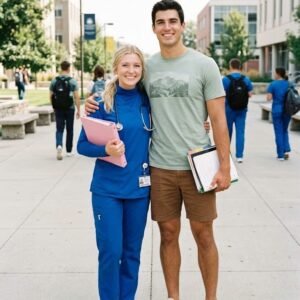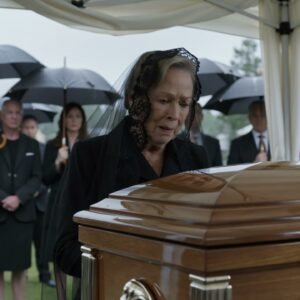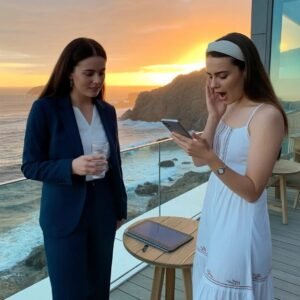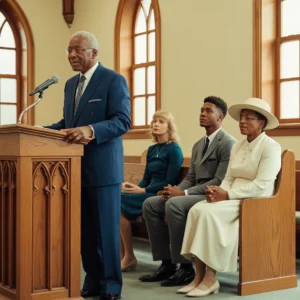
They hadn’t even set a place for me. I sat there for a long time, staring at that image on my cracked laptop screen. Something shifted inside me that night.
The ache I’d carried around for years—the longing for their approval, their attention, their love—didn’t disappear, but it changed. It hollowed out, like someone had scraped the inside of my chest with a spoon. And where the pain had been, there was quiet.
Strangely, that emptiness gave me something the pain never had. Clarity. Second semester of freshman year, I enrolled in Microeconomics 101.
The class was taught by Dr. Margaret Smith, a legend on campus. She’d been at Eastbrook for thirty years, published in every major journal.
Students whispered that she hadn’t given an A in five years and that she could destroy your confidence with a single raised eyebrow. I sat in the third row, the spot I always chose: close enough to see the board, far enough not to be called on unless I raised my hand. I took meticulous notes, read every chapter twice, and turned in my first essay on the marginal propensity to consume, expecting a B‑minus at best.
She returned the papers a week later. Mine had two letters scrawled in red at the top:
A+. Beneath the grade was a note in sharp, slanted handwriting.
See me after class. My heart dropped. Straight‑A kids like me know that those four words can mean you’re in trouble.
After the lecture, my classmates bolted for the exits, eager for lunch. I walked slowly down the aisle toward the front of the room. Dr.
Smith was packing her bag, her silver hair pulled back in a severe bun, reading glasses perched on the edge of her nose. “Francis Townsend,” she said without looking up. “Yes, ma’am.”
“Sit down.”
I sat in the front row, my backpack at my feet, pulse thudding in my throat.
She studied me over the rim of her glasses. “This essay is one of the best pieces of undergraduate writing I’ve seen in twenty years,” she said at last. “Where did you study before this?”
“Nowhere special,” I said.
“Public high school. Nothing advanced. No AP econ.”
“And your family?” she asked.
“Academics? Professionals?”
I hesitated. “My family doesn’t support my education,” I said finally, the words surprising me even as they left my mouth.
“Financially or otherwise.”
She set down her pen. “Tell me more.”
So I did. For the first time, I told someone the whole story: the favoritism, the rejection, the three jobs, the four hours of sleep, the Thanksgiving phone call, the Facebook photo with only three chairs.
When I finished, the classroom was empty. The clock on the wall ticked loudly in the silence. Dr.
Smith was quiet for a long moment. Then she said something that would change the trajectory of my life. “Have you heard of the Whitfield Scholarship?”
I nodded slowly.
“I saw it online, but it’s… impossible. Twenty students, nationwide.”
“Twenty students who have already beaten impossible odds,” she said. “The Whitfield is a full ride, plus a living stipend.
And at their partner schools, the Whitfield Scholar gives the commencement address at graduation.”
She leaned forward, her expression intent. “Francis, you have potential,” she said. “Extraordinary potential.
But potential means nothing if no one sees it. Let me help you be seen.”
The next two years blurred into a relentless rhythm. Wake at four.
Grind coffee beans at five. Class by nine. Library until midnight.
Repeat. I missed every party, every football game, every late‑night pizza run after midterms. While other students made memories, I built a GPA.
4.0. Six semesters straight. There were moments I almost broke.
Once, during a busy midterm week, I fainted behind the counter at The Morning Grind, right after the morning rush. I came to on the floor, the smell of espresso thick in the air, my manager’s worried face hovering above me. “Exhaustion,” the campus doctor said after running basic tests.
“Dehydration. You need to slow down.”
I nodded, promised I would, then went back to work the next day because I couldn’t afford not to. Another time, during junior year, I borrowed my friend Rebecca’s beat‑up Toyota Corolla to drive to a job interview for a better TA position.
I parked behind the library afterward and sat in the driver’s seat, my hands still on the steering wheel, and cried for twenty minutes. Not because anything catastrophic had happened. Just because everything had happened, all at once, for years.
But I kept going. Junior year, Dr. Smith called me into her office.
Papers were stacked in neat towers on her desk; a framed photo of her own graduation from some East Coast university sat in the corner. “I’m nominating you for the Whitfield,” she said without preamble. I stared at her.
“You’re serious?”
“Deadly.” A hint of amusement flickered at the corner of her mouth. “Ten essays, three rounds of interviews. It’ll be the hardest thing you’ve ever done.”
She paused.
“But you’ve already survived harder.”
The application consumed three months of my life. I wrote essay after essay about resilience, leadership, vision. I fielded phone interviews with panels of professors and foundation officers.
I signed forms for background checks. Dr. Smith and two other professors wrote glowing recommendation letters that made me blush when I read them.
Somewhere in the middle of all this, Victoria texted me. It was the first message from her in months. Mom says you don’t come home for Christmas anymore, she wrote.
That’s kind of sad tbh. I stared at the screen, thumb hovering over the keyboard. The truth was simple: I couldn’t afford a plane ticket from Ohio to New England.
My savings went to rent and textbooks and groceries that weren’t instant ramen. But even if I could have afforded it, I wasn’t sure I wanted to go. I put my phone face down on my desk and went back to my essay.
That Christmas, I sat alone in my rented room with a cup of instant noodles and a tiny paper Christmas tree Rebecca had made for me in the campus art studio. No family. No presents.
No drama. It was, somehow, the most peaceful holiday I’d ever had. The email arrived at 6:47 a.m.
on a Tuesday in September of my senior year. Subject: Whitfield Foundation – Final Round Notification. My hands were shaking so badly I could barely scroll.
Dear Miss Townsend, it began. Congratulations. Out of 200 applicants, you have been selected as one of 50 finalists for the Whitfield Scholarship.
Fifty finalists. Twenty winners. If all things were equal, I had a forty‑percent chance.
But all things were never equal. Not for kids like me. The final round would be an in‑person interview at the Whitfield Foundation headquarters in New York City.
Friday morning. Business attire. I opened a browser tab and checked bus and flight prices.
A last‑minute flight from Ohio to New York: at least $400, probably more. A cheap hotel in Manhattan: $150 a night if I was lucky. Rent was due in two weeks.
I checked my bank account. Balance: $847. I stared at the screen until the numbers blurred.
I was about to close my laptop, the familiar, bitter thought rising—of course it comes down to money again—when someone knocked on my door. “Frankie?” Rebecca’s voice. “You look like you saw a ghost.”
I opened the door and handed her my laptop without a word.
She scanned the email once, twice, then screamed. Literally screamed, loud enough that our neighbor banged on the wall. “You’re going,” she said when she calmed down.
“End of discussion.”
“Beck, I can’t,” I said. “I can’t afford it. The bus, the hotel—”
“Bus ticket: fifty‑three dollars,” she said briskly, already pulling up a travel site on her phone.
“Leaves Thursday night, arrives Friday morning. I’ll lend you the money.”
“I can’t ask you to—”
“You’re not asking,” she said. “I’m telling you.
Frankie, this is your shot. You don’t get another one.”
So I took the bus. Eight hours overnight, my head thumping softly against the cool glass window when the driver hit potholes on the interstate.
We rolled into Manhattan at five in the morning, the city still half asleep but already buzzing in that way New York always is. I changed into a borrowed navy blazer in the bathroom of Port Authority Bus Terminal, smoothed my thrift‑store pencil skirt, reapplied lip balm, and took the subway uptown to a sleek glass building that seemed to scrape the clouds. The Whitfield Foundation lobby smelled faintly of coffee and new carpet.