Do not soften this because she’s your mother. She used a key for a reason you did not authorize, brought another person into your home, and told you it was handled. That is breaking in with better manners.” I laughed then, unexpectedly.
Priya had that gift. She could turn my blurred instinct into a sentence sharp enough to keep. “She’ll tell everyone I called the police on my own family,” I said.
“And you’ll tell them you documented an unauthorized entry into your property,” she said. “Because that’s what happened. Alicia, they were counting on you wanting to sound nice more than you wanted to sound accurate.”
I slept badly.
Every shift of the maple branches against the siding sounded like someone on the porch. Every creak felt deliberate. By morning, my shoulders ached.
The next day passed in a blur of texts I ignored. My mother sent one: You are making a mistake you cannot undo. Rachel sent another: Can’t believe you humiliated me like that.
Neither asked how I was. Neither acknowledged what they had done. There are people who hurt you and then people who are offended by the inconvenience of your pain.
My family specialized in the second kind. By Thursday morning, I thought perhaps the drama had burned itself out. Then I woke to metal scraping against metal.
At first I thought I’d dreamed it. The room was still blue-gray with early light. Then I heard it again.
A deliberate clink, a muttered voice, the soft thud of footsteps on my porch. I grabbed my phone and opened the doorbell camera feed. My mother stood on my porch in a camel coat and oversized sunglasses, even though the morning was overcast.
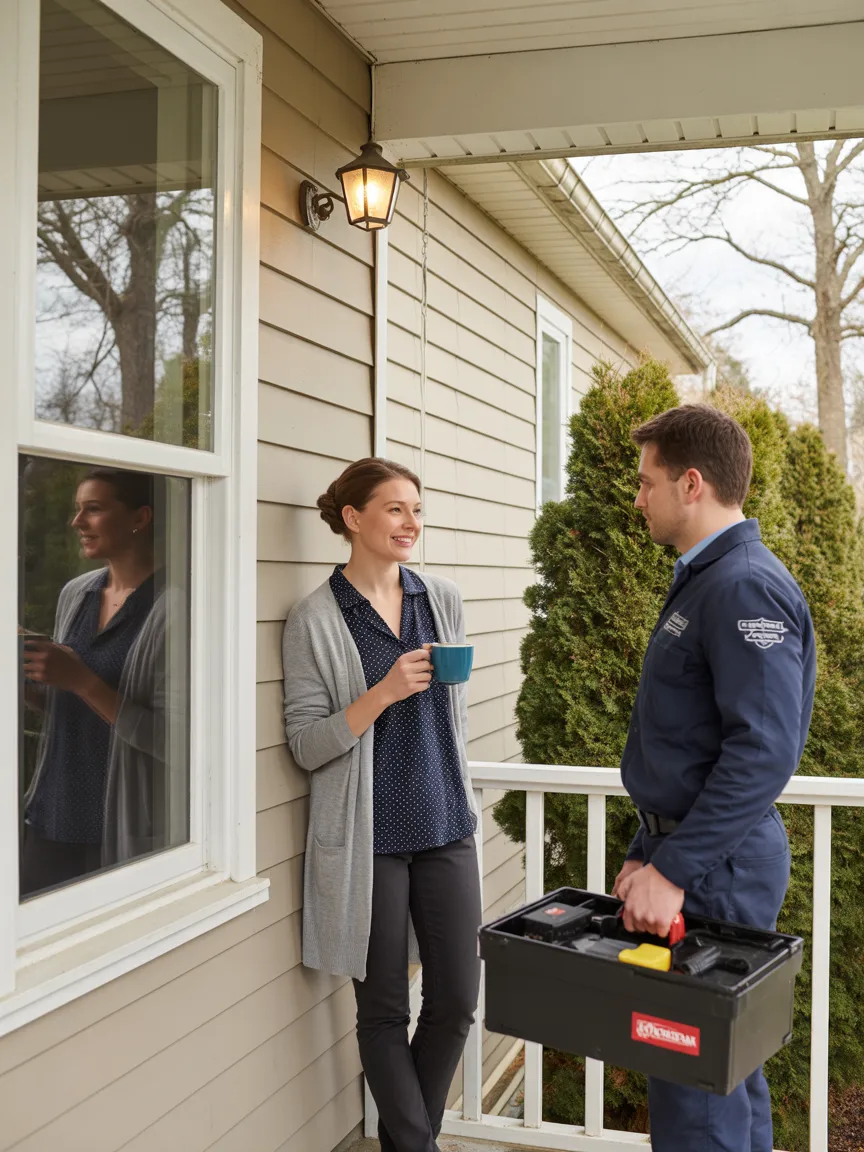
Beside her crouched a young man with a tool bag and a clipboard. A locksmith. He was examining my front lock while she talked at him with confident little hand gestures.
I sat up so fast I nearly knocked my water glass over. For two full seconds I simply stared at the screen. It was so outrageous, so nakedly audacious, that my mind briefly slid past anger into something almost academic.
Ah, I thought. So this is what escalation looks like when someone is truly convinced they outrank your consent. Then I got out of bed.
I did not run outside. I did not fling open the door in my pajamas and start yelling on the porch as she probably expected. I went into the kitchen.
I turned on the kettle. I ground coffee beans because the ritual steadied my hands. Then I called the non-emergency police line again.
I gave my name, address, the previous incident number, and said: “My mother is currently on my porch with a locksmith attempting to change my front-door lock without my permission.” The dispatcher’s tone changed on the word locksmith. She asked if I was inside. Yes.
Was the locksmith actively working? Appeared to be assessing it. Did the people outside have permission?
No. She told me officers were on the way. I thanked her, poured my coffee, added cream, and carried the mug to the front window.
It was one of the strangest moments of my life, standing there with hot coffee in my hand while my mother attempted to engineer access to my house from six feet away. The morning light was thin and colorless. Outside, my mother stood with the fixed upright posture she used whenever she was on the verge of being publicly wrong and had decided to out-straighten the situation.
The locksmith looked increasingly uncertain. Then she looked up and our eyes met through the glass. I watched her face move through surprise, then anger that I was not outside arguing on the terms she preferred, then something else: recognition.
She understood in that instant that she was being watched. Documented. Measured.
I lifted my mug and took a sip. Her mouth tightened. The police arrived five minutes later.
Two officers walked up the drive with the quiet efficiency of people who had long ago lost patience with family drama disguised as legal confusion. I opened my front door before they could knock and stayed in the threshold. I told them everything: the Tuesday incident, the documentation, the retrieved key, and now this.
The male officer looked at the locksmith. “Sir, who hired you?” He stood up quickly, looking miserable. “She did.
She said she was locked out of her daughter’s house and needed access because of an emergency.” “There is no emergency,” I said. My mother stepped forward. “This is ridiculous.
She’s overreacting. I’m her mother.” The woman officer’s expression did not change. “Do you own this property, ma’am?” “It belongs to my daughter, but—” “Then you cannot authorize a lock change without her consent.”
My mother’s voice sharpened.
“She’s upset and not thinking clearly.” I laughed, short and disbelieving. “I’m not the one who brought a locksmith to someone else’s house at seven in the morning.” The officer kept her attention on my mother. “Did the homeowner ask you to arrange this service?” “No, because she’s being unreasonable.” “That’s not the question.” The locksmith shifted uncomfortably and said if there was a dispute, he couldn’t proceed without the property owner’s authorization.
My mother snapped, “I’m her mother.” The male officer said, “That’s not a legal category of ownership.” I had to look away to keep from smiling. My mother drew herself up. “I was trying to help my daughter.” “By forcing access to her home?” She opened her mouth, and something in me clicked into perfect, shining certainty.
“I am completely capable,” I said. “That’s the problem, isn’t it? I’m capable of saying no.” The words hung in the damp morning air.
The officer told my mother that if she remained after being asked to leave, she could be cited for trespassing, and that any attempt to tamper with the locks could result in criminal charges. My mother gave me one last look, full of accusation and something almost like betrayal, as though I had failed her by not surrendering. Then she turned and walked to her car with the stiff, brittle stride I knew from every holiday where she had not gotten her way.
The locksmith apologized to me on his way back to the van. I believed him. He looked like a man who had expected an annoyed daughter and fou
nd himself in a generational boundary war before breakfast.
The officers added the new details to the prior incident and suggested I consider a no-trespass notice if my mother continued to escalate. The woman officer said, not unkindly, “You’d be surprised how often this starts as family misunderstanding and turns into something more serious.” After they left, I closed the door, locked it, and leaned back against it with my coffee still warm in my hand. My house was quiet.
But this time the quiet felt different. Not shaken. Secured.
That morning changed something more permanently than the first incident had. Tuesday had been shock. Thursday was pattern.
The locksmith made it unmistakable. My mother had not misunderstood me. She had not overstepped once in a burst of misguided love.
She had seen my no, weighed it, and decided it did not count. Then, when I enforced it, she tried to create a new route around it. She had brought tools.
Once you understand that someone treats your limits as a logistical problem rather than a moral boundary, your responsibility changes. You stop explaining. You start fortifying.
I took the day off work. I called a reputable locksmith and had everything replaced that afternoon. Smart locks on both exterior doors, new deadbolts, window sensors on the back of the house, two additional outdoor cameras, a motion detector for the side yard.
The locksmith, an older woman with silver hair braided down her back, listened to my summary and said only, “You’d be amazed how often the spare key is where the problem starts.” Her name was Celeste, and she moved through my house with brisk competence and zero nosiness. When she handed me the new emergency override cards, she said, “Don’t give this to anyone who thinks love outranks permission.” It was such a perfect sentence that I wrote it down later. By noon, the family texts arrived.
My aunt Carol first: Your mother says there’s been a misunderstanding. Why are the police involved? My cousin Melissa: Did you really threaten Mom with trespassing?
My uncle Brian, who had not spoken to me in six months: Family should be able to help each other without legal drama. Every one of them had the same shape. None asked what happened.